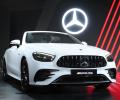
Electric vehicle (EV) penetration in the luxury car segment has seen a drop by nearly 3 percentage points in the GST 2.0 era with the internal combustion engine versions offering better total cost of ownership, according to industry players. While the trend is also visible in the mass market segment, it is the entry luxury segment that is witnessing a more marked shift towards internal combustion engine (ICE) vehicles as price difference between EV and ICE widened under the new GST rates.
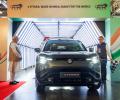
Japanese automaker Suzuki Motor Corporation will invest Rs 70,000 crore in the next five to six years in India to strengthen its operations in the country, its representative director and president Toshihiro Suzuki said on Tuesday. Prime Minister Narendra Modi on Tuesday kicked off exports of Maruti Suzuki India's first electric vehicle e VITARA to 100 countries and also inaugurated the production of lithium-ion battery cells for strong hybrid electric vehicles at its facility in Gujarat.
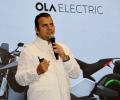
Why has the shift from ICE to electric slowed down despite initial enthusiasm?

The cost of the war is being counted not in the corridors of power in Washington or Tehran, but in Firozabad's darkened furnace rooms, Howrah's idle casting sheds, and a barbershop in Kochi where the wait is suddenly, inexplicably, an hour long, notes Prem Panicker in his must read blog on the Iran War.

Two-wheeler (2W) major Bajaj Auto on Friday posted its highest ever quarterly revenue and profit during the third quarter of 2025-26 (Q3FY26). Bajaj Auto's consolidated net profit for the quarter grew by 25 per cent year-on-year (Y-o-Y) to Rs 2,749 crore, with the revenue also growing 23 per cent to Rs 16,204 crore.
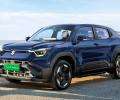
Speaking at the unveiling of the model at the Auto Expo, held as part of the Bharat Mobility Show, Suzuki Motor Corporation representative director and president Toshihiro Suzuki said the electric SUV would be exported to various regions, including Europe and Japan. Suzuki Motor Corporation, which has around 58 per cent stake in Maruti Suzuki India, plans to make India a global production hub for the model.

Maruti Suzuki sold more cars than ever before, earned more money, and saw many first-time buyers choosing small cars again.
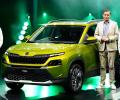
'Growth will definitely continue to come most from the sub-four-metre SUV segment, primarily because that is where the heart of economy and affordability is. Naturally, that will keep pushing the share of that segment (in overall PV sales) higher.'

The government on Wednesday approved a Rs 7,280 crore scheme to promote manufacturing of rare earth permanent magnets, a move which would help reduce India's dependence on China.

Bajaj Auto is planning a slow, calibrated push to take the Chetak, its electric scooter, to more than 100 countries on the strength of its distributor network and market-specific localisation rather than an aggressive global rollout, reports Sohini Das.
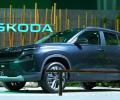
Skoda India is focusing on cleaner fuel options, including CNG and EVs, while compact SUV Kylaq drives volumes, expands first-time buyers and strengthens the brand in India's competitive market
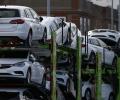
The production-linked incentive (PLI) scheme for the automobile sector has created market distortions, excluded innovation-led electric two-wheeler (e2w) makers, and failed to convert cost advantages into export competitiveness, with 77 per cent of export volumes driven by non-PLI models, said a report released by the Centre for Domestic Economy Policy Research (C-DEP) on Friday.

Prime Minister Narendra Modi on Tuesday announced the signing of the India-EU Free Trade Agreement (FTA), saying it accounts for 25 per cent of global GDP and one-third of global trade.

Maruti Suzuki will introduce eight SUVs over the next five years taking its overall model range to 28 as it aims to regain 50 per cent market share in the domestic passenger vehicle segment, Suzuki Motor Corporation Representative Director and President Toshihiro Suzuki said on Wednesday.

The Indian Defence Ministry has approved the procurement of 114 Rafale fighter jets from France, a significant step towards bolstering the Indian Air Force's combat capabilities. The decision comes ahead of French President Emmanuel Macron's visit to India.

Network scale seen as central to tapping smaller markets.

Despite a 2.8 per cent fall in 2025 volumes, Mercedes-Benz India reported its best-ever revenue and profitability, led by top-end models, AMG growth and higher BEV mix.

TVS Motor Company on Wednesday said it has partnered with connected lifestyle brand Noise for electric vehicle-smartwatch integration to enable riders to connect with their vehicles.

Electric vehicle (EV) manufacturers breathed a sigh of relief after the GST Council on Wednesday night retained the concessional 5 per cent rate on EVs, though they now face competition from small petrol and diesel cars, which will attract a lower 18 per cent levy.

Mahindra & Mahindra plans to manage rare earth magnet supplies through alternative sourcing channels for the next nine months and will pursue 'engineering efforts' to address the raw material shortage situation amid growing product portfolio, according to a senior company executive. The imposition of export restrictions by China on key rare earth magnets has resulted in supply chain bottlenecks, impacting the user industries, including the auto and electronics sectors.
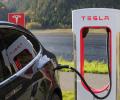
BMW Group India is unfazed by the prospect of Tesla entering the electric vehicle market here and feels it will help grow the segment, according to its Managing Director and CEO Vikram Pawah. The group, which sold a total of 1,249 units of electric cars in India across two brands -- BMW and MINI -- has already sold 646 units in the first quarter of 2025 and is keeping its forecast of 15 per cent of its total sales in India coming from EVs, Pawah told PTI in an interview.
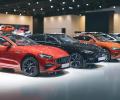
Starting January, the market is expected to welcome models like the Tata Punch 2025 which is expected to be around 6 lakh, Mahindra BE 07 EV around 29 lakh, Maruti WagonR Electric around 8.5 lakh, Toyota 3-Row SUV around 14 lakh, and Volkswagen Tera to be around 8 lakh.

Japanese auto major Honda considers India a key market for its future growth alongside the US and Japan, according to Honda Cars India President and CEO Takashi Nakajima. The Tokyo-headquartered automaker, which operates in India through a wholly owned subsidiary, plans to drive in more SUVs in the country, as the segment continues to see robust sales across varied price points.
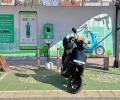
Electric two-wheeler (e2W) companies are upset with some of their suppliers of heavy rare-earth magnet-powered electric motors, who have objected to their proposal - under consideration by the government - that would allow e2W original equipment manufacturers (OEMs) an exemption from localisation norms on electric motors, thereby enabling them to continue receiving the 5,000-per-vehicle subsidy.V

'We serve more than 1.2 billion trips annually and have over 1.5 million active earners each month using the platform.'

After a record-breaking year, India's automobile industry is entering 2026 on a relatively strong footing, with sales growth expected in the 6-8 per cent range. The outlook is underpinned by policy support, including GST rationalisation, easing monetary conditions, and income tax relief, which together are likely to improve affordability and sustain consumer demand across vehicle segments.

India is set to take its first steps towards its own human space flight when the uncrewed Gaganyaan mission soars to the skies later this year. Private players in the space sector are also gearing up for launching satellites on home-built rockets.
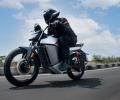
Clearly, some of the bullishness of the early days has gone missing. Ola's market share is slipping amid rising competition from incumbents like Bajaj Auto and TVS.

India's two-wheeler industry is seen growing 6-9% in 2026, though a proposed ABS mandate for sub-125cc models could push up prices and temper volumes.

While many areas compete for resources, defence, education, and adaptation deserve focus for maximum impact, suggests Laveesh Bhandari.

The Indian government has reassured citizens that the country has sufficient reserves of petrol, diesel, and LPG, and that refineries are operating at high capacity despite global supply chain disruptions. They have urged citizens to avoid panic buying and hoarding.

Honda Motorcycle and Scooter India (HMSI) on Wednesday forayed into the fast-growing domestic electric mobility market with the introduction of e-scooters, ACTIVA e: and QC1, with swappable and fixed batteries. With this, the Japanese two-wheeler maker will now be competing with other legacy players such as Bajaj Auto, Hero MotoCorp, TVS Group as well as pure EV players like Ather and Ola, who already have a good presence in the segment, which is growing at 34 per cent year-on-year.

'In India's competitive automotive market, staying relevant means continuously raising the bar.'

On the back of an aggressive asset monetisation push, the government will press the throttle on the build-operate-transfer (BOT) model - under which private developers fund highway construction - for future highway development, Union Minister for Road Transport and Highways Nitin Gadkari said.
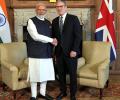
For UK automakers, market access to India will be limited by quantity caps and phased tariff cuts, especially on petrol, diesel and electric vehicles.
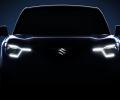
However, the company has not provided a timeline for the launch of the small electric car.
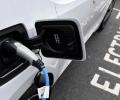
'The testing and certification have been completed, and implementation could occur within a year, depending on the number of vehicles.'
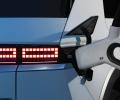
India may see its busiest EV festive season in 2025 with SUVs, luxury cars and scooters set to launch, but rare-earth supply bottlenecks risk delaying rollouts.

In March 2021, Ola Electric founder Bhavish Aggarwal was seen surveying an empty 500-acre land surrounded by shoe factories, temples, bakery shops, coconut trees and dusty roads in Pochampalli town of Krishnagiri district, Tamil Nadu. Many excavators and workers were busy at the construction site to build the Ola Futurefactory for electric vehicles.
'At present, hybrids emit lesser carbon despite using fuel than pure play electric cars.' 'That is because EVs have to be charged and 76 per cent of the country's electricity is still coal-based and not renewables.'
